Good Read

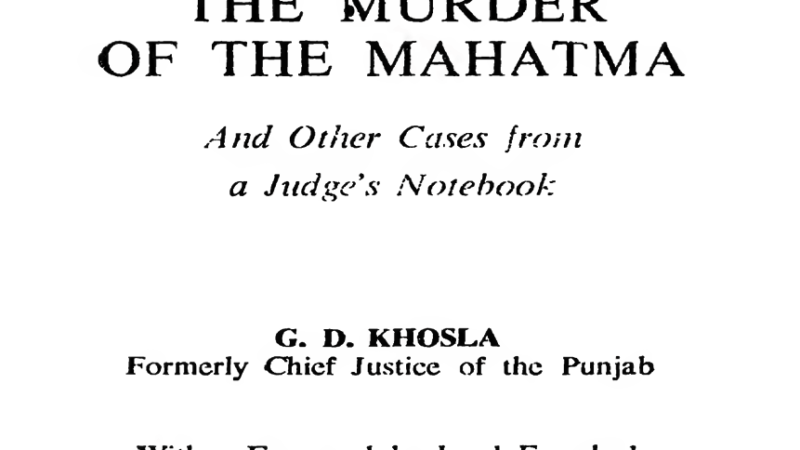
The Murder of Mahatma Gandhi

The Murder of Mahatma Gandhi — A Judicial Eye on a Nation’s Darkest Day The Murder of Mahatma Gandhi is a compelling and meticulously argued book by G. D. Khosla, a distinguished Indian judge and legal thinker. The book revisits the assassination of Mahatma Gandhi on 30 January 1948 in New Delhi, examining the crime through the lens of law, evidence, and historical responsibility. Rather than treating the tragedy as a single, isolated act, Khosla places it within the wider political and ideological tensions of post-Independence India. Drawing from court proceedings, testimonies, and documented records of the conspiracy, the book offers readers a grounded and analytical account of how the assassination unfolded and why it was able to happen. What Makes This Book Stand Out Why You Should Read It This book is not just about the murder of a leader — it is about the moral and political consequences of intolerance in a newly independent nation. For readers interested in modern Indian history, political violence, or landmark criminal cases, The Murder of Mahatma Gandhi offers a serious, thought-provoking account grounded in legal reasoning and historical evidence. Rather than treating the tragedy as a single, isolated act, Khosla places it within the wider political and ideological tensions of post-Independence India. Drawing from court proceedings, testimonies, and documented records of the conspiracy, the book offers readers a grounded and analytical account of how the assassination unfolded and why it was able to happen. What Makes This Book Stand Out Why You Should Read It This book is not just about the murder of a leader — it is about the moral and political consequences of intolerance in a newly independent nation. For readers interested in modern Indian history, political violence, or landmark criminal cases, The Murder of Mahatma Gandhi offers a serious, thought-provoking account grounded in legal reasoning and historical evidence. Whether you are a student, researcher, or general reader, this work remains a valuable reference for understanding one of the most traumatic moments in India’s modern history — and the lessons it continues to carry.

No Comments Read More
Good Read

Happiness Mantra

Happiness Mantra You hit your targets. You build great teams. Your calendar is full, and your role is desirable. Yet, when the laptop closes at night, a quiet question lingers: “𝑊ℎ𝑦 𝑑𝑜𝑒𝑠𝑛’𝑡 𝑡ℎ𝑖𝑠 𝑓𝑒𝑒𝑙 𝑎𝑠 𝑓𝑢𝑙𝑓𝑖𝑙𝑙𝑖𝑛𝑔 𝑎𝑠 𝑖𝑡 𝑙𝑜𝑜𝑘𝑠?” That silent gap between professional success and personal fulfilment is where professionals who look “successful” from the outside but crave emotional clarity, inner alignment, and a more grounded way of leading and living. 𝐓𝐡𝐞 𝐏𝐫𝐨𝐟𝐞𝐬𝐬𝐢𝐨𝐧𝐚𝐥 𝐏𝐚𝐫𝐚𝐝𝐨𝐱 𝐨𝐟 𝐇𝐚𝐩𝐩𝐢𝐧𝐞𝐬𝐬Many high achievers feel a disconnect: the more they climb, the less centered they become. External wins—promotions, bonuses, and recognition—do not automatically lead to inner peace. This results in restlessness, anxiety, and emotional fatigue. 𝑯𝒂𝒑𝒑𝒊𝒏𝒆𝒔𝒔 𝑴𝒂𝒏𝒕𝒓𝒂 identifies this as the “professional paradox of happiness” and offers a way to break the cycle of success-driven unhappiness by realigning goals with core values and inner needs. The book encourages leaders to assess where their drive has turned into pressure and where ambition has strayed from authenticity. It provides practical reflections to help them reconnect with what truly matters, so professional growth does not come at the expense of emotional well-being. Research shows that happiness is not a “𝒔𝒐𝒇𝒕” topic; it has tangible business outcomes. Happier workers are measurably more productive, creative, and engaged. Studies link happiness to productivity gains of 12 to 20 percent and stronger organisational performance. Leaders with higher emotional well-being and emotional intelligence achieve better results, foster healthier cultures, and are viewed as more effective by their teams. Happy leaders create positive emotional climates where people feel safe to contribute, innovate, and take ownership. This “emotional contagion” means a leader’s inner state shapes team morale, collaboration, and performance, making happiness a true strategic advantage rather than a personal indulgence. Defining a mindset framework that focuses attention and shapes consciousness. It is not a slogan to repeat, but a way of thinking that asserts happiness is created from the inside out through empowered thought and intentional choices. Instead of waiting for the next milestone to feel better, leaders learn to cultivate happiness as a daily practice. Core practices include mindfulness, gratitude, and honest self-reflection—simple but effective disciplines that strengthen emotional stability over time. When professionals treat happiness as a skill, they become more resilient under pressure, clearer in decision-making, and more authentic in relationships, which enhances both leadership presence and life satisfaction. If you are a CXO, founder, or senior leader who has “achieved a lot” but is ready to feel more aligned within, this book is for you: Happiness Mantra

No Comments Read More
Good Read Health Tips

The Journey Home: Unveiling the Evolving Dimensions of Spirituality

Spirituality, a vast and profound realm of existence. While it may just be a word to some, but for me, it embodies the art of living with mindfulness, empathy and grace. It is about becoming a gentle observer of one’s inner world, cultivating awareness of one’s thoughts, words, and actions, and consciously channelizing them toward one’s highest good and greatest joy. As we navigate through life and gather experiences, our comprehension of spirituality continually evolves and deepens, revealing ever greater clarity and purpose. Over the years, my own interpretation of spirituality has evolved from an abstract idea to a practical compass that helps me face life’s challenges with clarity, compassion, and cohesion. I believe spirituality is not about adhering to rigid rules, but about fostering awareness and moving through life with ease and grace. This guiding force has taught me to slow down, turn inward, and make conscious choices aligned with my highest self, transforming my life into an odyssey of meaning, balance, and joy. With time, I’ve realized that spirituality isn’t about escaping or detaching from the world, but about engaging with it with greater awareness and openness. With this realization comes modesty, fostering harmony between yourself and the world around you. You begin to feel a profound connection with all of life, yet you’re no longer bound by the need to hold on. There’s a certain freedom in that – loving fully without attachment, caring deeply without control. Like the wind, spirituality flows through you, reminding you that true presence comes not from grasping, but from simply being.  While spirituality is an extensive and deeply personal subject, carrying different connotations for different people, yet, at its core, I believe, true spirituality shares the common purpose for many of us: There may be a shared thread that binds many spiritually evolved individuals and, yet spirituality is neither a fixed notion nor a universal formula that fits everyone. It is a living, transforming journey that reveals itself over time. It evolves with us as we experience life’s joys, sorrows, challenges, and quiet moments. What once felt unclear gradually becomes an inner compass, not pointing us toward perfection, but toward presence, self-awareness, and authenticity. In a world that often pulls us outward, spirituality calls us inward. It invites us to slow down, listen deeply, and live intentionally. It reminds us that we are more than our habits, more than our reactions, and certainly more than what we own or achieve. It teaches us to meet life with humility, to love without clinging, and to find stillness even in motion. In a world that prioritizes speed, success, and external approval, spirituality offers something more profound – an invitation to pause, introspect, learn and evolve. It teaches us that real strength is found not in rigidity, but in a compassionate and forgiving heart; that courage can coexist with vulnerability; and that true connection doesn’t depend on attachment. Spirituality empowers to step back from the constant noise of everyday life and observe our experiences with awareness and a sense of detachment. It instills within us the capacity to remain impartial, non-judgmental, and neutral in our perceptions and interactions. It leads us back to ourselves—more whole, more grounded, more grateful and more compassionate. It enables us to lead our lives not from fear or habit, but from clarity, love, empathy and conscious choices. In conclusion, it is important to recognize that spirituality extends beyond a mere intellectual concept; it is a transformative journey of self-realization. I sincerely hope that, regardless of where you stand on this path, you continue to grow and inspire through the intuitive wisdom of your inner being. May you find peace, purpose, and enlightenment as you progress. Most importantly, may your journey – no matter how intricate – ultimately lead you back home, to your authentic self.     Author’s Social Media Handles:    http://www.facebook.com/POSbyMeenakshiRaina https://www.linkedin.com/in/meenakshi-raina-21a0423a     EmailContributor : Meenakshi Raina

No Comments Read More
Culture Good Read

The Vanishing Community: Understanding the Decline of the Kashmiri Pandit Population

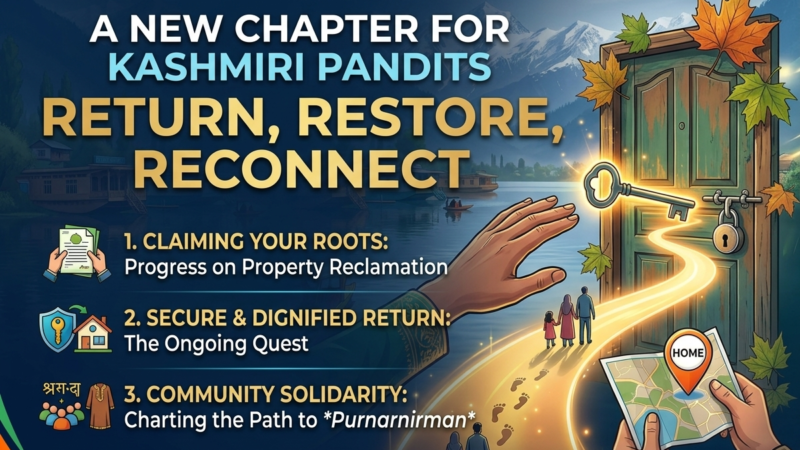
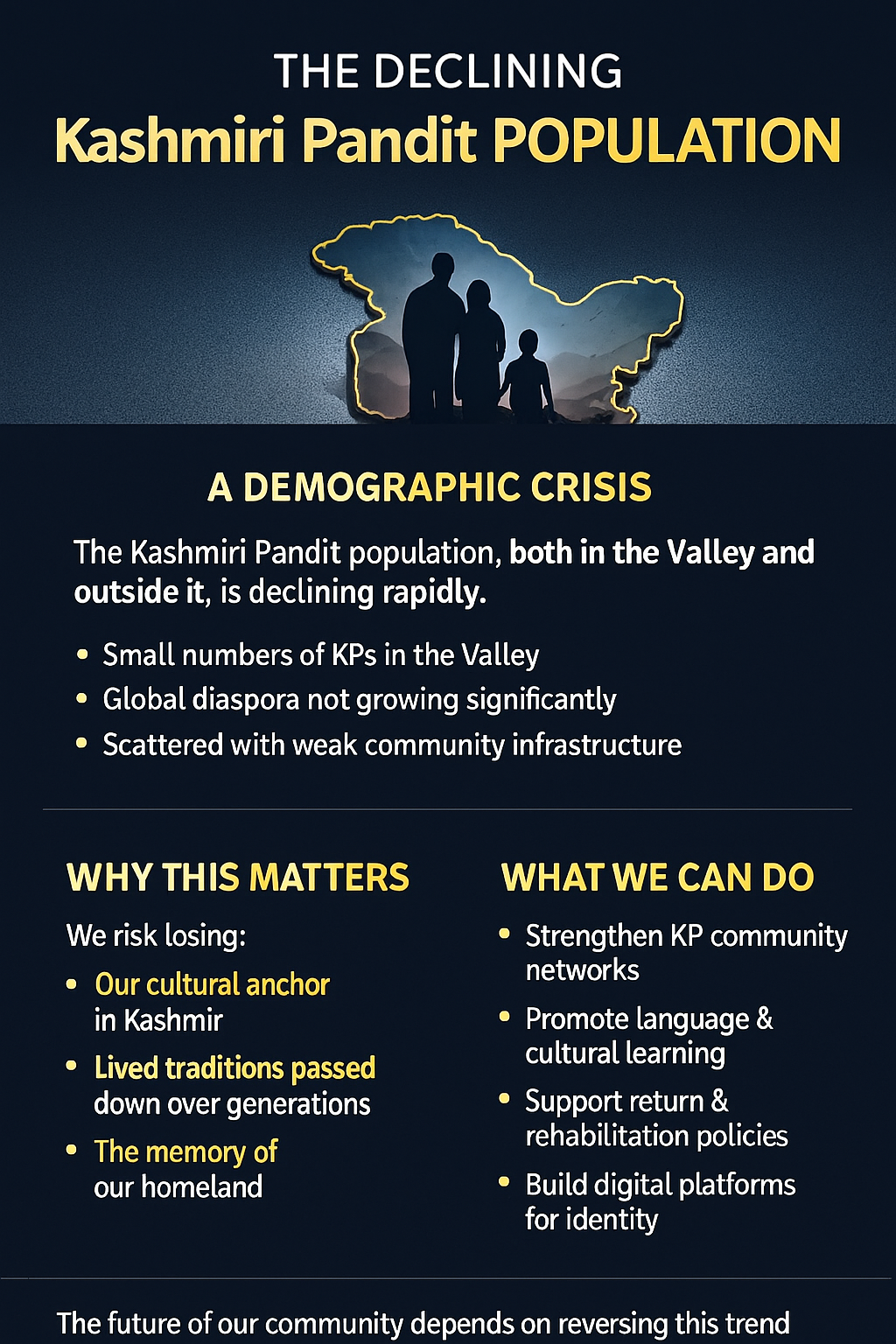
A Silent Decline — And Why It Matters to Every Kashmiri Pandit Across India and around the world, Kashmiri Pandits have built successful lives, careers, and communities. But behind this outward progress lies a demographic crisis that threatens the survival of our identity. Today, the Kashmiri Pandit population — both inside the Valley and across the diaspora — is shrinking at a pace we can no longer ignore. This is not just a statistic.This is a warning for the future of our community. A Community That’s Scattered — And Shrinking Before the 1990s, Pandits lived in a close-knit cultural ecosystem. Today, two realities define our demographic landscape: In Kashmir Only a few thousand Pandits remain. Those who stayed back face limited opportunities, social isolation, and aging community structures. Outside Kashmir The diaspora is widespread but small. Low birth rates, late marriages, urban transitions, and intercity mobility have slowed natural population growth significantly. Together, these trends mean fewer Pandits everywhere — in the Valley, in India, and globally. Why the Numbers Are Falling The demographic decline is the result of long-term pressures: The outcome is clear:We are becoming a community of memories instead of a community of numbers. The Cultural Cost of Fewer People A declining population leads to declining cultural presence: Culture cannot survive on nostalgia alone. It needs people — visible, present, rooted. Why Those Living Outside Kashmir Must Pay Attention Even if you were born outside Kashmir…Even if you’ve never lived in the Valley…Even if you feel safe and settled where you are… This demographic decline affects you, your children, and the future of our collective identity. If current trends continue, our community risks: We cannot allow this to happen in our generation. How the Diaspora Can Help Not everyone can move back — and that’s okay. But every Kashmiri Pandit can contribute to demographic strength. 1. Strengthen Community Networks Local KP groups, gatherings, and youth clubs keep the identity active. 2. Encourage Cultural Learning Language, rituals, festivals, history — especially for children. 3. Support Policies for Return & Revival Diaspora voices matter. Push for rehabilitation, housing clusters, and youth opportunities in Kashmir. 4. Promote Digital Platforms & Knowledge Sharing Modern identity needs modern tools. Apps, online communities, Kashmiri language revival, cultural documentation — all are essential. 5. Build Community Bonds Weddings, youth meets, cultural events — these directly influence demographic sustainability. This Is Our Moment The demographic decline of Kashmiri Pandits is not a Kashmir issue.It is a global community issue. Our generation — the youth, the diaspora, the professionals — stands at a turning point. If we act now, we can secure our identity for the next hundred years.If we stay silent, we risk becoming a footnote in history. The time to respond is now.The responsibility is ours. KPONLINE.IN Informing. Connecting. Preserving our identity – Digital Homeland of Kashmiri Pandits

1 Comment Read More
Culture Events Good Read

Festivals and Rituals

KPonline Quiz Series: Kashmiri Pandits Festivals and Rituals KPonline serves as a Digital Homeland for Kashmiri Pandits, offering an innovative platform that bridges the community with their rich cultural heritage through engaging educational content. The platform’s Quiz Series represents a dedicated initiative to preserve, promote, and share the profound heritage, culture, and religious traditions of the Kashmiri Pandit community. About the Quiz Series The KPonline Quiz Series is an ongoing educational initiative designed to inform and engage participants about the rich Kashmiri Pandit heritage and culture. This interactive format serves multiple purposes: Today’s Focus: Kashmiri Pandits Festivals and Rituals Today’s quiz is on the topic of Kashmiri Pandit Festivals and Rituals. It consists of multiple-choice questions designed to enhance awareness and understanding of the unique cultural celebrations and traditions of the Kashmiri Pandit community. This quiz aims to connect the youth with their rich heritage in an engaging and educational way. Historical Significance Kashmir has been recognized as the land of Rishis and Gurus, with traditions dating back over 5000+ years. The region’s historical importance includes: Cultural Heritage Context The quiz series emphasizes Kashmir’s role as a multilayered tapestry of culture, where Kashmiri Pandits have maintained their distinct identity through: Educational Impact Through this quiz series, KPonline continues its mission to serve as a digital homeland where Kashmiri Pandits can: The Kashmir History quiz represents just one facet of the comprehensive cultural education that KPonline provides, ensuring that the rich Kashmiri Pandit heritage remains alive and accessible to present and future generations

No Comments Read More
Culture Good Read Religious

History of Kashmiri Pandits

KPonline Quiz Series: Celebrating Kashmiri Pandit Heritage KPonline serves as a Digital Homeland for Kashmiri Pandits, offering an innovative platform that bridges the community with their rich cultural heritage through engaging educational content. The platform’s Quiz Series represents a dedicated initiative to preserve, promote, and share the profound heritage, culture, and religious traditions of the Kashmiri Pandit community. About the Quiz Series The KPonline Quiz Series is an ongoing educational initiative designed to inform and engage participants about the rich Kashmiri Pandit heritage and culture. This interactive format serves multiple purposes: Today’s Focus: History of Kashmiri Pandits Today’s quiz centers on Kashmir History, exploring the vast and complex historical narrative of the Kashmir Valley and its significance to the Kashmiri Pandit community. Kashmir’s history encompasses: Historical Significance Kashmir has been recognized as the land of Rishis and Gurus, with traditions dating back over 5000+ years. The region’s historical importance includes: Cultural Heritage Context The quiz series emphasizes Kashmir’s role as a multilayered tapestry of culture, where Kashmiri Pandits have maintained their distinct identity through: Educational Impact Through this quiz series, KPonline continues its mission to serve as a digital homeland where Kashmiri Pandits can: The Kashmir History quiz represents just one facet of the comprehensive cultural education that KPonline provides, ensuring that the rich Kashmiri Pandit heritage remains alive and accessible to present and future generations

No Comments Read More
Culture Good Read Saints

Lal Ded Quiz

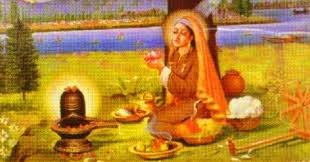
Discover The Mystic Poetry of Lal Ded: Take the Quiz and Celebrate Our Heritage! Kashmiri culture is vibrant, ancient, and deeply spiritual — and no figure embodies its mystical heart more than Lal Ded, also known as Lalleshwari. Born in the 14th century, Lal Ded was a saint-poetess whose powerful verses, called Vakhs, shaped Kashmiri language, literature, and spirituality. Her poetry transcends time, offering insight into life, the soul, and the divine. Who Was Lal Ded? Lal Ded, fondly called Mother Lalla, is revered not only as a poet but as a mystic, yogini, and visionary who challenged social norms and religious orthodoxy. Married young and facing hardship, she renounced worldly life to pursue a spiritual path deeply rooted in Kashmir Shaivism and resonating across religious lines, including Sufism. Through her Vakhs — more than 260 verses steeped in philosophy and devotion — Lal Ded speaks of the inner journey, the rejection of superficial rituals, and universal human values. Her legacy is both a cultural treasure and a spiritual guide. Why Take the Lal Ded Quiz? What To Expect? Our Lal Ded Quiz presents 15 true/false questions covering her life, teachings, poetry, and impact. Whether you’re a scholar or a curious learner, the quiz will inspire reflection and appreciation for her role in shaping Kashmiri identity. Join Us in Celebrating Lal Ded Take a few moments to immerse yourself in the poetic world of Lal Ded. By participating in this quiz, you join thousands of others passionate about preserving and promoting our rich Kashmiri heritage. Ready to celebrate Lal Ded and deepen your cultural knowledge?Click here to start the Lal Ded Quiz now and unlock the secrets of the mystic poetess’s verses! “Her Vakhs are not just poems — they are the voice of Kashmir’s soul.” Embrace the legacy. Honor the mystic. Celebrate Lal Ded.

No Comments Read More
Culture Good Read

Koshur Heritage Quiz

KPonline is thrilled to announce the launch of an exciting new Koshur Quiz series—a vibrant and inspiring interactive journey designed for the Kashmiri Pandit community to discover, update, and upgrade their knowledge about our rich culture, heritage, and religion. The Spirit of Koshur Quizzing KPonline will present a curated set of engaging quiz questions covering treasured traditions, language, festivals, history, and spiritual wisdom unique to Kashmiri Pandits. This series isn’t just about recalling facts—it’s a celebration of our ancestry and a playful invitation to every generation to become active participants in preserving our legacy. Whether you’re a seasoned scholar or just starting to connect with your roots, every quiz is tailored to inspire you, spark healthy curiosity, and encourage learning. Why Join the Koshur Quiz Series? Make Learning Fun! With every quiz, participants gain the chance to be featured as Heritage Guardians on KPonline. Join the friendly competition, test your Koshur know-how, and encourage your family to participate—learning together becomes an unforgettable experience. A Call to Every Kashmiri Pandit This quiz series is more than a platform—it’s a movement to empower, unite, and uplift our community. Whether you’re a student, professional, elder, or culture enthusiast, KPonline’s Koshur Quiz offers a joyful way to keep traditions alive and relevant in the digital age. Are you ready to take the challenge? Click Here and join the Koshur Quiz series, and let’s celebrate our heritage together! Our culture is our strength. Our quiz is your gateway—step forward, learn more, and help shine a light on the Kashmiri Pandit story for the world.

No Comments Read More
Culture Good Read News

The Digital Homeland Imperative

The Digital Homeland Imperative: Unifying Kashmiri Pandits Through Global Digital Platforms The displacement of the Kashmiri Pandit community in 1990 marked not just a physical exodus but the beginning of a profound digital transformation journey. Today, as an estimated 300,000 to 400,000 Kashmiri Pandits live scattered across the globe, the imperative for a unified digital platform like KPonline has never been more critical. This platform represents more than a technological solution—it embodies the concept of a “digital homeland” that can preserve, connect, and empower a diaspora community while ensuring their cultural survival for future generations. The Current Digital Fragmentation Crisis Scattered Digital Presence and Lost Connections The Kashmiri Pandit diaspora currently exists in a state of digital fragmentation that mirrors their physical displacement. While some community members have embraced social media platforms to maintain connections, as evidenced by initiatives like Radio Sharda, which broadcasts to listeners in 108 countries, and Facebook groups that reunite separated families, these efforts remain largely isolated and uncoordinated. The community’s digital footprint reveals both resilience and fragmentation. Young Kashmiri Pandits are actively creating content on platforms like Instagram and TikTok. However, these individual efforts, while valuable for cultural expression, lack the systematic coordination needed for comprehensive community building and preservation. The Challenge of Cultural Transmission Research indicates that the transmission of Kashmiri language and culture faces significant challenges across generations. While first-generation migrants maintain strong linguistic connections, second and third-generation community members often struggle with basic Kashmiri phrases. This linguistic erosion threatens the core identity of the community, as language serves as the primary vehicle for cultural transmission. The need for systematic cultural preservation becomes even more urgent when considering that many elderly community members, who serve as living repositories of traditional knowledge, are passing away without fully transferring their wisdom to younger generations. Digital platforms offer the possibility of capturing, organizing, and disseminating this invaluable cultural heritage before it is lost forever. The Transformative Power of Unified Digital Platforms Beyond Social Media: Creating True Digital Communities The evolution from fragmented social media presence to unified digital platforms represents a paradigm shift in diaspora engagement. Unlike traditional social media platforms that prioritize algorithmic engagement and advertising revenue, dedicated community platforms like KPonline can focus entirely on serving the specific needs of the Kashmiri Pandit diaspora. The benefits of such unified platforms extend far beyond simple social networking. Research on diaspora digital engagement reveals that successful platforms create what scholars term “digital diasporic publics”—spaces where community members can engage in meaningful cultural, political, and social discourse while maintaining connections to both their heritage and their current homes. The Multifaceted Value Proposition A comprehensive analysis of diaspora community platforms reveals several critical advantages that KPonline and similar platforms can offer to the Kashmiri Pandit community. These benefits span cultural preservation, community connection, economic opportunities, and identity maintenance. Cultural preservation emerges as the highest-impact benefit, as digital platforms can serve as repositories for traditional knowledge, recipes, stories, and practices that might otherwise be lost. The platform can facilitate the documentation of oral histories, the teaching of traditional arts, and the celebration of cultural festivals in virtual spaces that transcend geographical boundaries. Community connection represents another vital function, enabling Kashmiri Pandits scattered across continents to maintain meaningful relationships and support networks. This is particularly crucial for a community that has experienced forced displacement and continues to grapple with the psychological impacts of exile. Strategic Implementation Framework for Digital Unity Addressing the Challenge-Opportunity Balance The implementation of a unified digital platform for the Kashmiri Pandit diaspora must carefully navigate the complex landscape of challenges and opportunities that characterize modern digital community building. Analysis of successful diaspora platforms reveals that while significant challenges exist, the opportunities for transformative impact far outweigh the obstacles. Technology adoption challenges, while significant, are being rapidly overcome by improving digital literacy and the increasing availability of user-friendly platforms. The COVID-19 pandemic has accelerated digital adoption across all age groups, creating a more receptive environment for comprehensive digital community platforms. Privacy and security concerns, which rank high among community challenges, can be addressed through robust data protection measures and community-controlled governance structures. The success of platforms like the iDiaspora initiative demonstrates that diaspora communities can effectively manage their digital presence while maintaining data sovereignty. Community-Led Governance and Participation The most successful digital diaspora platforms employ community-led governance models that ensure authentic representation and meaningful participation. For KPonline to achieve maximum impact, it must implement governance structures that give community members genuine agency in platform development and content curation. This participatory approach aligns with emerging trends in digital community management, where users expect not just to consume content but to actively shape their digital environments. The platform should incorporate features that allow community members to propose initiatives, vote on platform changes, and take leadership roles in various community functions. Integration of Emerging Technologies The future success of KPonline will depend significantly on its ability to integrate emerging technologies that enhance user experience and community engagement. Artificial intelligence can power personalised content recommendations, intelligent matchmaking for matrimonial services, and automated translation services that bridge linguistic gaps within the community. Virtual and augmented reality technologies offer unprecedented opportunities for cultural preservation and experiential learning. These technologies can enable virtual visits to historical Kashmir sites, immersive cultural festivals, and realistic recreation of traditional practices that might otherwise be difficult to maintain in diaspora communities. Future-Oriented Vision and Technological Roadmap The Evolution Toward Digital Homelands The concept of a “Digital Homeland” represents the ultimate goal of unified diaspora platforms—creating virtual spaces that provide the sense of belonging, cultural continuity, and community support traditionally associated with physical homelands. For the Kashmiri Pandit community, this digital homeland can serve as a space where the essence of Kashmir is preserved and accessible regardless of physical location. The technological roadmap for achieving this vision involves several evolutionary phases, each building upon previous capabilities while introducing new possibilities for community engagement and cultural preservation. The current era (2023-2025) represents the “Community Platforms Era,” characterized by the

No Comments Read More
Culture Good Read Temples

Ashta Bhairavas (Guardians of Srinagar)

During the reign of King Pravarasena II (6th century CE), Srinagar was divided into eight sectors, each protected by a specific Bhairava—known as the Ashta Bhairavas : These deities were collectively known as the Rashtradhipatis—protectors of the eight wards. Their collective abode was believed to be at Chakreshvara, beneath Sharika (Hari Parbat) Other Local/Area-Specific Bhairavas Beyond the Ashta Bhairavas, the Kashmiri Pandit community venerates numerous village and area-specific Bhairavas, often considered guardians of those locales: In Kashmir Shaivism, Bhairava represents the Supreme Reality and is a fierce manifestation of Lord Shiva, embodying protective energies and the destruction of negative forces. The Ashta Bhairavas, or Eight Bhairavas, are particularly significant, guarding and controlling the eight directions. They are also closely associated with the Herath festival, where Bhairava is worshipped as Vatuk.  Key aspects of Bhairavas in Kashmir:

No Comments Read More
error: Content is protected !!

Sign In

Register

Reset Password

Please enter your username or email address, you will receive a link to create a new password via email.